Ice Climbing in Camden, Maine
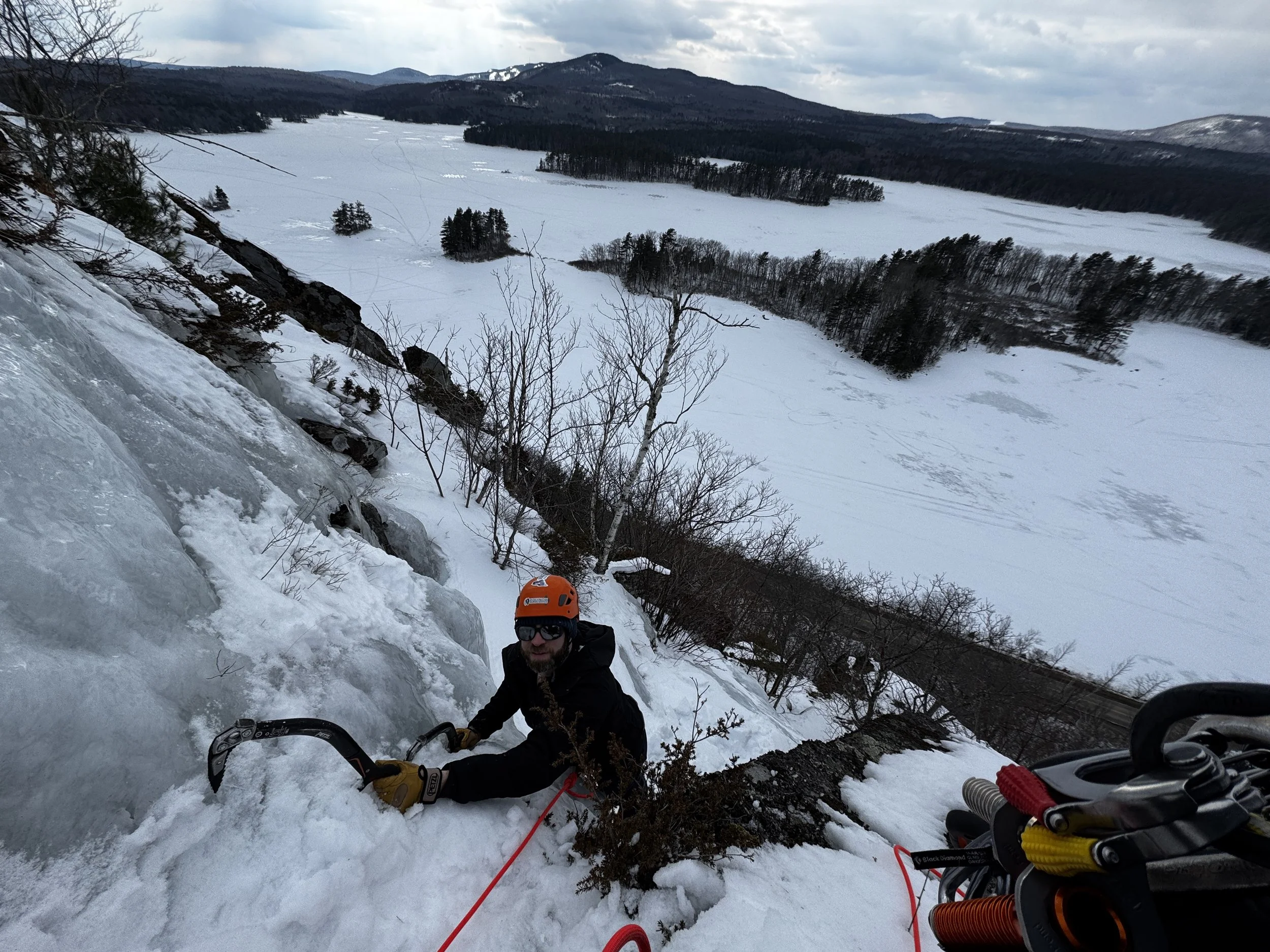
A Local Guide to the Thin, Scrappy, Historic Ice of the Camden Hills
Ice climbing in Camden has never really been about finding one enormous frozen waterfall and climbing pitch after pitch of fat ice.
That isn’t what the Camden Hills do.
Our ice is thinner, stranger, more scattered, and often much more temporary.
Some routes form almost every winter. Others need a very specific combination of groundwater, snow, temperature, and prolonged cold. A few may appear beautifully for several days and disappear almost as quickly. Some of the best-known “ice climbs” in Camden involve just as much rock climbing, frozen turf, chimneying, and traditional protection as they do swinging tools into ice.
That unpredictability is one of the things I love most about climbing here.
You don’t simply wake up and ask:
What route do I want to climb today?
More often, you ask:
What did Camden decide to give us?
After enough winters, you begin learning the personality of each drainage.
The Left Cataracts are often my dependable choice.
Maiden Cliff tends to come in later but can hold onto ice longer because of its colder, more northerly aspect.
Hot Spot can suddenly turn on later in the season, but once stronger sun starts reaching it, you need to climb it while it is there.
Barrett’s Cove might offer thin smears and mixed lines one week and be almost completely bare the next.
Then there are the little things: Dragon’s Butt, odd chimneys, narrow gullies, and unnamed flows that somehow become part of your winter routine.
Camden ice climbing rewards people who pay attention.
And I think that is part of what makes it special.
A Little Camden Ice History
The history of climbing in Camden was never documented as carefully as it probably should have been.
The old Camden guide records climbing here as far back as the 1940s and ’50s, with climbers including George Smith, Peter Metcalf, Paul Ross, Charlie Porter, and the strong Bangor climbing community exploring the hills during the following decades.
For ice climbing specifically, one of the most important figures was Geoff Heath, who arrived in the area in the mid-1970s. The old guide credits Heath, together with partners including Dave Getchell Sr. and Dave Getchell Jr., with climbing essentially all of the difficult ice flows then known at Maiden Cliff and Barrett’s Cove. Camden guide 5th ed draft 9-20-…
That history still matters.
Many of these routes were established with equipment that would look primitive compared with what we climb on today. Protection was often rock gear placed around or even through thin ice. Short screws were less dependable. Tools were different. Crampons were different.
But the terrain is largely the same.
Some of these old climbs are still serious.
Understanding Camden Ice Grades
Camden grades need context.
A NEI 3 in Camden is not necessarily the same experience as climbing a fat WI3 waterfall at a major destination crag.
The old Camden guide makes this point indirectly throughout its descriptions. Many routes combine ice with rock moves, frozen turf, cracks, chimneys, and sections where rock protection is more useful than an ice screw. Some technically moderate routes also have serious protection ratings.
That means I pay attention to the whole description.
NEI 3 X tells me a lot more than NEI 3.
M5 on a well-protected crack is different from M5 where you are wondering if the next patch of verglas will take your tool.
Conditions can also change a route dramatically.
A chimney filled with thick ice may be straightforward one winter and become a difficult mixed climb the next.
For consistency, I’ve mostly retained the historic Camden grades below. Mountain Project sometimes uses modern WI notation instead—for example, it currently lists Heathrow at WI3+, Joe’s Route at WI2, and Clothesline at WI3+. Mountain Project
The number is a starting point.
Conditions determine the climb.
The Left Cataracts
If someone asks me where I most consistently go ice climbing in Camden, this is probably the answer.
The Left Cataracts are my workhorse winter area.
They generally hold ice well. When they form fat, they can stay in for quite a while. There are enough different angles and features that I can usually find something appropriate for the people I am climbing with.
That is why I use this area so often for beginner and intermediate ice climbing and why we can run half-day programs here.
The historical guide calls it a tremendous ice-climbing practice area, with a large low-angle main flow surrounded by several steeper and mixed lines. Camden guide 5th ed draft 9-20-…
It is also usually quiet.
That is one of the funny things about Camden ice climbing.
If I see another climber out here, I usually know who they are.
Or they know who I am.
It is a small world.
Far Left Cataract — NEI 1
Several hundred yards left of the main Left Cataract are a collection of easy, low-angle ice smears.
They are not a destination in themselves, but they belong in the record.
The Tear — NEI 3+
A short, steep ice bulge left of the wall containing Everdrip, followed by lower-angle terrain.
Everdrip — NEI 3+
One of the better distinct lines on this side of the Cataracts.
The route enters an alcove and follows a steeper ramp, with the exit becoming noticeably harder when the ice is thin. The historical guide specifically notes that rock gear can become useful in lean conditions. Camden guide 5th ed draft 9-20-…
Unnamed / Project — NEI 3+, 5.10, M4–5
Between Everdrip and the curtain to its right is a mixed corner documented in the Camden draft as a project or newer line established by Brad Wilson and Alan Rees.
The upper corner is generally mixed.
Direct Curtain — NEI 4
Immediately right of Everdrip is a steep curtain that rarely forms completely to the ground.
Left-Facing Corner — NEI 4
Farther right is another corner that occasionally develops enough ice to climb.
This is one of those Camden features that might barely exist one year and suddenly become a real route the next.
Never Drip — M5
A very Camden climb.
A left-facing corner leads toward a roof with a prominent horizontal crack. The historical description has the climber reaching the stance below the roof on rock, then using a hanging icicle to gain lower-angle ice above.
Small cams protect the horizontal.
That combination—rock, hanging ice, traditional gear, and then easy ice above—is exactly why I don’t think of Camden simply as an ice-climbing area. Camden guide 5th ed draft 9-20-…
Left Cataract — NEI 2+
This is the centerpiece.
The old guide describes the main Cataract as roughly 300 feet of low-angle ice with numerous possible variations. Camden guide 5th ed draft 9-20-…
It is one of my favorite places for someone learning to ice climb.
You can work on footwork.
You can practice swinging tools without immediately climbing steep ice.
You can learn how to move efficiently.
And as you improve, there are steeper variations that continue making the same piece of ice useful.
When it forms thick, it can hang around for a surprisingly long time.
That dependability is why I keep returning.
The Right Cataract & Bixler’s Area
The Right Cataract is less concentrated and generally less dependable than the Left side, but when things are good there are several worthwhile lines.
The old guide describes the area as a collection of smears and flows with two particularly recognizable routes: Right Cataract and Bixler’s Way. Camden guide 5th ed draft 9-20-…
Right Cataract — NEI 2+
A distinct gully rising out of the broader collection of smears.
It makes another good moderate climbing option when conditions cooperate.
Bixler’s Way — Moderate to Very Hard
Bixler’s Way is one of my favorite Camden ice climbs when it comes in well.
The route follows a steep, right-leaning corner, with the upper constriction providing the main difficulty. The old guide makes an important point: when there is a lot of ice, the crux can be relatively straightforward. When the route is thin, it can become dramatically harder.
Medium cams are recommended in lean conditions.
The historical description also records a possible direct finish up a column to the left, and in exceptional conditions an extremely steep and fragile sheet can cover the entire left wall, producing climbing around NEI 5. Camden guide 5th ed draft 9-20-…
That variability is pure Camden.
Same route.
Very different experience.
Bixler’s Backdoor
Immediately right of Bixler’s Way is a line that has become personally important to me.
John Sidic and I established Bixler’s Backdoor around the time Equinox Guiding Service was getting started.
The route works through a scrappy chimney right of Bixler’s Way.
It isn’t particularly glamorous.
That might be why I like it.
The chimney tends to stay protected from the sun, and I have found that it can hold on surprisingly late. I’ve climbed it on warmer days when more exposed ice nearby was already deteriorating.
Bixler’s Backdoor probably isn’t something someone drives across New England specifically to climb.
But it is exactly the kind of route that makes Camden feel like home.
Maiden Cliff
When someone wants to move into harder Camden ice, Maiden Cliff is usually where my mind goes.
It behaves differently from the Cataracts.
Maiden tends to form later.
But because the cliff is colder and much of the terrain has a northerly aspect, it can also hold ice later once it finally comes together.
Mountain Project divides this broader zone into Frostbite Falls, Pete’s Puzzle, and Blue Vein, and describes the area as a collection of rock, ice, and mixed climbing where parties are often alone. Mountain Project
That still feels accurate.
It is steeper.
More committing.
And considerably more complex than the Left Cataracts.
Frostbite Falls
Boris Badunov — M4
At the left side of the overhanging portion of Frostbite Falls, committing dry-tooling leads toward a thin slab of ice.
The historical guide describes good rock protection below, with the thin ice itself becoming more difficult to protect.
First ascent: Alan Rees and Ben Townsend. Camden guide 5th ed draft 9-20-…
Flying Squirrels Under the Moon of Discrimination — NEI 4+, M4
One of Camden’s great route names.
An ice column leads onto a thin slab and eventually toward an icy runnel breaking through a roof. Rock gear can be found around the roof, but the rest of the climb can be sparsely protected.
The old guide also records a variation finish through a V-slot. Camden guide 5th ed draft 9-20-…
Peter’s Route
Immediately right of Flying Squirrels is an icy slab leading toward powerful mixed climbing over a roof.
Above the roof, the angle initially eases before steepening again near the top.
The historical draft does not give a clean modern grade here, so I would rather preserve the description than invent one. Camden guide 5th ed draft 9-20-…
Pete’s Puzzle Area
This is where Maiden begins feeling like a true winter climbing crag.
The wall is much larger than Frostbite, with numerous ice and mixed systems spread across it.
Local Hero — M6
One of the lines I think is especially worth preserving.
Around the corner left of Double Clutch is a short, clean right-facing corner. The historical description calls for strenuous dry-tooling on good rock protection.
First ascent: Alan Rees. Camden guide 5th ed draft 9-20-…
Dirty Dancing — M3
A short flow leads into flaky mixed terrain and finishes on an exposed ramp.
Canadian Ballet — M6
A low-angle ice slab leads toward a wall and roof.
The roof is the crux, after which a bushier corner leads to the finish.
The old guide credits Alan Rees and Ben Townsend with the first ascent. Camden guide 5th ed draft 9-20-…
El Toro Acorralado — M7+
A pair of dihedrals create a much harder mixed problem.
The lower corner may contain ice in good conditions, while the upper corner provides steep mixed climbing protected by small cams, wires, and fixed pins.
Double Clutch — NEI 4
The obvious one-pitch ice flow at the left edge of the main wall.
The old guide warns that it can be hollow and fragile.
Most parties rappel from the tree.
Turf Battle — M3
A broken right-trending gully just right of Double Clutch.
A short ice patch leads into dry-tooling and turf climbing, eventually reaching the Kiss of the Spider Woman belay.
Kiss of the Spider Woman — NEI 3, 5.8 or A1
A real Camden adventure.
A short ice spout leads to a rock overhang. The overhang can be freed or aided, followed by thin ice and more climbing toward the Pete’s Puzzle finish.
The old guide notes that in exceptional conditions, an ice pillar can form across the rock crux, turning the route into a more continuous NEI 4 ice line. Camden guide 5th ed draft 9-20-…
Pete’s Puzzle — NEI 3+, 5.7, R/X
Pete’s Puzzle is one of those routes where the grade barely tells the story.
Thin ice leads to a mixed escape from a tight alcove and onto a thinly iced slab.
The historical guide points out that rock gear can sometimes be placed through the ice at the crux—which tells you almost everything you need to know about how thin this route can be.
From the big tree ledge above, there are multiple finishes: an easier ice gully, a more awkward icy dihedral, or the rock chimney known as The Rebirther, 5.8. Camden guide 5th ed draft 9-20-…
Iron Maiden — NEI 4, M4
About a hundred yards right of Pete’s Puzzle, thin ice climbs the margin of a slab toward an ice spout breaking through an overhang.
When the ice spout is absent, the old guide notes that a turf-and-moss corner can provide an alternative.
Above is a tight right-leaning chimney with thin ice and good rock protection.
First ascent: Alan Rees and Ben Townsend. Camden guide 5th ed draft 9-20-…
Blue Vein Area
Blue Vein is one of the routes that, to me, captures Camden ice climbing better than almost anything else.
This small wall contains several important mixed routes.
Varicose Vein — NEI 3+, 5.4
A thinly iced ramp on the left finishing through a steeper bulge.
Rock, Paper, Scissors — M8
A much harder mixed route.
In exceptional conditions, an icicle forms from the overhang. The route climbs rock behind it before continuing through dry-tooling on a left-arching crack and finishing on an icy slab.
The old guide credits Peter Lataille with the first ascent. Camden guide 5th ed draft 9-20-…
Blue Vein — M5
A classic Camden mixed climb.
The route follows a narrow ice hose up the back of a steep chimney and negotiates two overhanging chockstones. The upper one may have little more than verglas for tool placements.
The old Camden guide actually notes that some climbers consider Blue Vein the best ice climb in Camden.
It also says it does not form often.
That combination seems appropriate.
A full rock rack can be useful in addition to screws.
First ascent: Jeff Heath. Camden guide 5th ed draft 9-20-…
Mixed Route Right of Blue Vein — approximately M6
The draft records another mixed climb immediately to the right of Blue Vein, around 5.10/M6, credited to Brad Wilson.
The route information in the draft was still incomplete, so I think the responsible thing is to preserve its existence without pretending we know more than we do. Camden guide 5th ed draft 9-20-…
Skyline Crag
Skyline is better known as a rock crag, but winter adds several ice lines to this small, shady wall.
The historical Camden draft specifically documents three. Camden guide 5th ed draft 9-20-…
Fat Boy — NEI 2+
The thicker flow near the left end, interrupted by two short vertical sections.
Little Sister — NEI 4
An extremely thin verglas line on an outside corner.
The old guide notes that meaningful protection does not appear until the ledge roughly fifteen feet up.
Twister — NEI 3+
The obvious chimney line near the pillar.
It is described as sustained and awkward despite its modest length.
First ascent: Jerry Cinnamon and Ben Townsend. Camden guide 5th ed draft 9-20-…
Mountain Project currently shows only a single ice route under Skyline in its Camden area breakdown, which is another example of why I think preserving the older record matters. Mountain Project
The Outback / Lost Valley
The Outback is primarily known today for rock climbing, but winter brings ice into the head of the canyon.
Lost Valley Cataract — NEI 1–2
The obvious low-angle flow near the head of the canyon.
There are several possible finishes.
Half Pipe — NEI 2–3
The distinctive right-hand exit from Lost Valley Cataract.
King of Swing — NEI 4+, 5.8
The real adventure here.
About a hundred feet right of Lost Valley Cataract, steep ice leads toward a wild leftward traverse. The old guide gives options of exiting through an overhanging corner or continuing farther left onto thinner, more questionable ice. Camden guide 5th ed draft 9-20-…
These are exactly the kinds of lines that disappear from collective memory when nobody writes them down.
Hot Spot
Hot Spot is an interesting one.
It often comes in later in the season.
When it finally does, I pay attention.
Because as the winter progresses and the sun angle changes, the ice can deteriorate surprisingly quickly.
When Hot Spot is good, I think:
Go now.
The old Camden guide jokingly suggests “Wet Spot” might be a more appropriate summer name because of how much water moves through the cliff. That same water creates the winter climbing. Camden guide 5th ed draft 9-20-…
Ben and Jerry’s Ice Climb — NEI 2+
A moderate flow through a broad, indistinct gully with numerous variations.
In good winters, a separate line around NEI 3+ can form to the left.
Alan’s Corner — NEI 3+, M6
Low-angle ice leads into a short, steep flow that ends below a prominent corner.
From there, the route becomes dry-tooling, with a bolt protecting the corner.
The historical guide recommends a light rock rack plus a few screws. Camden guide 5th ed draft 9-20-…
The draft also notes that in strong winters additional pillars and mixed climbs may form to the right of these established lines.
That is worth preserving too.
Mountain Project currently separates Hot Spot rock climbing from a Hot Spot ice area, but presently lists only one ice route in that sub-area. Mountain Project
Barrett’s Cove in Winter
Barrett’s may be known primarily as Camden’s historic rock-climbing cliff, but winter transforms it.
Water begins finding weaknesses invisible during the summer.
Chimneys fill.
Smears develop.
Rock routes become mixed routes.
And sometimes a completely new line appears for a few days.
Barrett’s contains some of Camden’s most interesting—and most serious—winter climbing.
Arizona Highways — approximately NEI 3
A thinly iced slab on Barrett’s Left.
The exact difficulty varies considerably with conditions.
Solstice Wall — M4 X
The gully reaches Broadway before the upper climbing enters a chimney and eventually traverses onto extremely thin ice.
The protection on the upper wall is the real story.
Solstice Chimney — M3+
A more protectable alternative to Solstice Wall.
The line uses chimney climbing, cracks, chockstones, and mixed terrain rather than committing completely to the thin upper face.
Frozen Smile — M5
A summer crack becomes a mixed route involving rock, turf, a short ice bulge, and rock protection.
Big Chimney — NEI 3+, M5 R
A damp, unappealing summer corner that can become surprisingly good winter climbing.
The historic description contains one of my favorite pieces of Camden beta:
“Swearing was involved.”
That sounds about right.
Cachongas — M6
A rarely forming smear leads up and right from the Big Chimney into an overhanging slot.
Good rock gear and short screws are useful.
Skye Crack — NEI 3+, 5.4, X
A thin and serious winter line.
The historic description says the first meaningful protection in typical conditions may be roughly sixty feet above the ground.
The X matters much more to me than the NEI 3+.
Hollywood Waltz — NEI 4 X
A rare ice line sharing the summer Hollywood Waltz terrain.
The upper section is particularly ephemeral.
Heathrow / Central Gully — roughly NEI 3; Mountain Project WI3+
Heathrow is one of the defining winter routes at Barrett’s and among the more consistent major flows on the cliff.
That does not mean it is casual.
The first pitch can be thin and poorly protected before the flows merge, with rock gear becoming increasingly useful above. The upper pitch continues toward the top on thinner ice.
Mountain Project currently lists Heathrow as WI3+ and features it as one of Barrett’s classic routes. Mountain Project
Pharaoh’s Beard — NEI 3
A left-leaning chimney above Skye Crack.
Its difficulty changes dramatically with the amount of ice.
Spiderline — NEI 3+
A rare winter version of Spider.
The historic material warns that protection may be extremely limited except near the exit.
Clothesline — NEI 3–4
A chimney that can range from friendly when filled with ice to dramatically harder when the ice is thin and buried in the back.
Mountain Project currently lists Clothesline at WI3+. Mountain Project
Shoestring — NEI 3 / Mixed
Another of the upper flows that appears when winter conditions align.
Joe’s Route — NEI 2+
A long mixed ramp leading toward the upper right side of Barrett’s.
The historical guide calls it a good introduction to mixed climbing, while also warning about exposure to falling ice from steeper routes above in warm conditions. Camden guide 5th ed draft 9-20-…
Mountain Project currently lists it as WI2. Mountain Project
Continental Ice Sheet — NEI 3+, 5.6
The massive upper-right flow.
This is one of the more striking pieces of winter ice at Barrett’s when it forms well.
The route climbs sustained ice toward an alcove before finishing on rock or mixed terrain.
Continental Direct
The less frequently formed left-hand variation into Continental Ice Sheet.
Tangled Up in Blue — NEI 3–4, 5.7, X
A rare and committing winter version of the rock route.
The old guide specifically notes very little protection on the crux ice.
Big City Woman — NEI 3, 5.7
Steep ice gives way to mixed climbing and an awkward chimney.
In exceptional conditions, an extremely thin direct start may form at around NEI 4 X.
Tritium Witch — NEI 3+, R/X
When winter is generous, a thin ribbon of ice can form directly up the Tritium Witch headwall.
The historical guide advises “crafty” rock protection.
Upper Joe’s Route Flows — NEI 2–3+
In good winters, as many as half a dozen short thin flows may appear on the slabby wall right of the upper Joe’s Route gully.
These can sometimes be linked into longer outings.
Joe’s Drip — NEI 3
A spout in a left-facing corner on the Lower Right Side of Barrett’s.
Unnamed Steep Column — NEI 4
A short column farther right.
The old guide records the feature but does not give it a formal name.
Waterfall — NEI 3
A cascading flow between the steep column and Tangled Up in Blue Start.
It forms rarely.
Tangled Up in Blue Start — NEI 3+
The most obvious flow in the center of the Lower Right cliff band.
When conditions are exceptional, it can connect through to the upper Tangled Up in Blue line for a complete winter ascent.
Joe’s Route Direct — NEI 2+
A lower ice start that eventually joins the final portion of Joe’s Route.
The first pitch climbs the right-hand flow, followed by an icy corner/gully and easier terrain above. Camden guide 5th ed draft 9-20-…
The Road Cut
Jailbait — Grade 4, M6
South of Barrett’s is the large Route 52 road cut.
The old guide documents Jailbait here: steep thin ice past a piton, followed by rock climbing above.
First ascent: Ryan Howes. Camden guide 5th ed draft 9-20-…
Ocean Lookout / Upper Megunticook
Most people think about the excellent rock climbing up here, but winter climbing exists too.
The historic material describes three significant winter lines.
Dendritic Gully — NEI 4, M3
Disconnected ice flows wander up a slabby wall with several steeper steps.
The guide says the route requires exceptional conditions.
Three short pitches.
Scottish Gully — Moderate
A long mixed gully involving easy mixed climbing, a short ice bulge, and easier terrain above.
When the ice is absent, rock and turf alternatives may allow the route to continue.
Socrates — NEI 2+
A thin slab at the far left end of Ocean Lookout, threading between overhangs.
Geographically, this is essentially the upstream continuation of the Left Cataract drainage.
The old guide explains the name as a reference to the descent:
death by hemlock. Camden guide 5th ed draft 9-20-…
That feels appropriately Camden.
Middle Cliffs
I debated whether to put this section online.
Middle Cliffs is one of those places I enjoy partly because I almost never see anyone there.
But if the goal of this article is to preserve Camden climbing history, I think the routes deserve to be recorded.
I am intentionally keeping the approach information fairly general.
The old guide describes the Middle Cliffs as an obscure basin between Barrett’s and the Cataracts containing several excellent winter routes. Camden guide 5th ed draft 9-20-…
The Smear — NEI 2 X
A very thin, low-angle slab below an old avalanche scar.
Uprising — NEI 3+
A steep, thin flow trending left from behind a large tree.
I Had a Dream — M5
A steep ice-glazed wall leads to a layback corner, an overhang, and blind tool placements in a flared crack.
The historic guide describes the route as surprisingly well protected by rock gear.
The Stream — NEI 2–3
The obvious frozen waterfall at the head of the basin.
Stairmaster — NEI 3+ to M5
A series of ice and rock steps along the right side of the amphitheater.
Conditions radically affect the difficulty, and protection is primarily rock gear.
Axe Buster — NEI 3+
A short, steep wall of often-thin ice right of The Stream. Camden guide 5th ed draft 9-20-…
This is one of those corners of Camden I hope remains quiet.
Knowing a route exists does not mean every place needs to become crowded.
Mount Battie
A couple of unusual winter routes have also been documented on Mount Battie.
Tower Gully — NEI 1+
An easy gully south of the water tower that often forms early.
The old guide notes that substantial snowfall tends to bury the relatively thin ice.
Ghoul Street — NEI 4+
A rarely complete icicle hanging from a large roof above the cemetery near Gould Street.
Camden Bliss — approximately Grade 5
In exceptional winters, a much larger free-standing column can form beside Ghoul Street.
The guide emphasizes its southern exposure and relatively small attachment point at the roof.
That alone should tell you something about evaluating it carefully. Camden guide 5th ed draft 9-20-…
Dragon’s Butt and the Smaller Camden Lines
Not every worthwhile piece of Camden ice made it into the historical guides.
Dragon’s Butt is one of those lines I think of every winter because it tends to form with surprising consistency.
It is part of the scrappier side of Camden climbing—the little flows, buttresses, chimneys, and gullies that you gradually learn by spending enough winters here.
There are almost certainly more.
The old Camden guide itself admits that no guide to the area can really be complete. Ice is too variable. Different winters produce different features, and dozens of variations have been climbed without ever receiving formal names. Camden guide 5th ed draft 9-20-…
I like that.
There should still be something left to find.
How I Choose Where to Climb
I don’t approach a Camden ice day with a rigid plan.
I usually have several ideas.
For beginners and intermediate climbers, I often start by thinking about the Left Cataracts. The terrain is concentrated, the main flow can remain in for a long time, and there are enough different options to adjust the day as needed.
For someone who wants steeper and harder climbing, I begin thinking about Maiden Cliff, Pete’s Puzzle, or Blue Vein.
If Bixler’s Way is fat, I want to climb it.
If Hot Spot is finally in, I want to get there before the sun starts dismantling it.
If one of the rare Barrett’s lines has formed, sometimes that becomes the day.
The trick is not becoming attached to an objective.
Winter climbing rewards flexibility.
Why Camden Ice Is So Quiet
One of the things I value most about ice climbing in Camden is how little traffic there is.
That feels increasingly unusual in New England.
There are bigger climbing areas.
There are more dependable climbing areas.
There are certainly places with longer routes and more impressive waterfalls.
Camden has never really competed with them.
And I don’t think it needs to.
Here, you can hike into the woods on a cold January morning and spend the entire day without seeing another climber.
If you do see someone, there is a pretty good chance you know them.
Or they know someone who knows you.
That little world has existed here for generations.
It is one of the things I hope we can preserve.
A Note About Conditions
Everything in this article is condition-dependent.
Especially the ice.
A route described as NEI 3 in an old guide may bear almost no resemblance to what you find today.
Ice can delaminate.
Columns can detach.
Water can undermine apparently thick flows.
Rock protection can change.
Trees and fixed anchors age.
And warming temperatures can transform a route surprisingly quickly.
I think this is especially important in Camden because so many climbs exist near the margin between ice climbing and mixed climbing.
You have to look at what is actually there.
Not what the guidebook says should be there.
Why I Keep Coming Back
Camden ice can be frustrating.
A climb you have been watching all week can disappear before the weekend.
A beautiful curtain can turn into running water.
A route that looked fat from the road can reveal itself to be an inch of ice over rock.
And sometimes you hike all the way in and discover that the answer is simply:
Not today.
But when one of these routes finally comes together, it feels special.
You know you caught it at exactly the right moment.
You know it might not look the same tomorrow.
And you know that next winter you will probably be checking the same drainage all over again.
That is Camden ice climbing.
Thin.
Scrappy.
Quiet.
Historic.
Sometimes ridiculous.
And when everything lines up—
really, really good.